
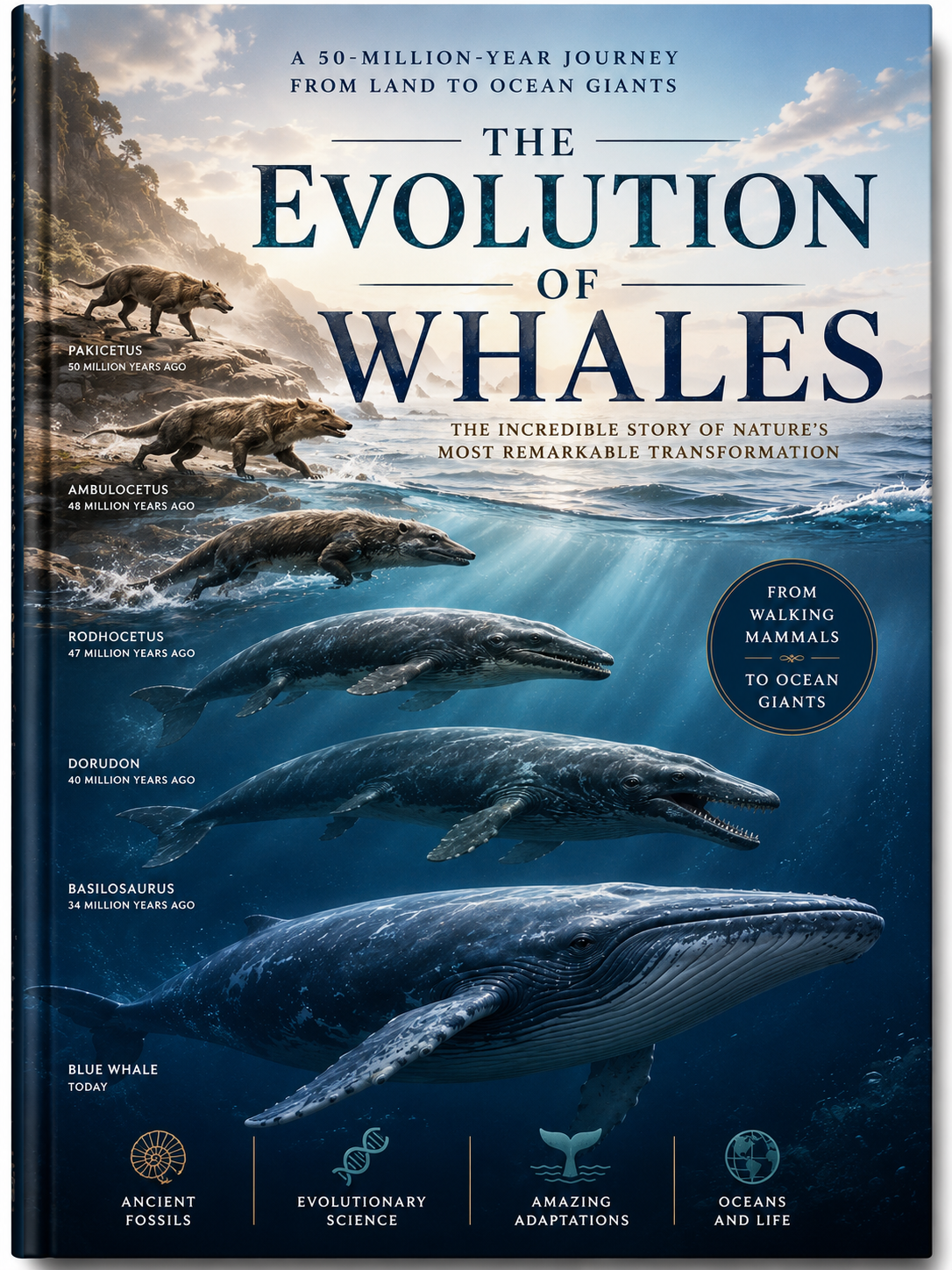
Description
This book tells the deep-time story of how whales transformed from small, land-dwelling mammals into the largest animals on Earth. It follows a 50-million-year evolutionary journey step by step, showing how gradual biological changes—shaped by natural selection—allowed a wolf-like ancestor to become a fully aquatic giant.
At its core, the book explains three big ideas:
1. Evolution is gradual and continuous.
Whales did not suddenly become ocean animals. Fossils like Pakicetus, Ambulocetus, and Basilosaurus reveal a slow transition from land walking to swimming, then to fully marine life.
2. Every major whale feature has a history.
Flippers evolved from legs, blowholes from nostrils, tail-powered swimming from spinal flexibility, and echolocation and baleen from specialized adaptations for survival in the ocean.
3. Whales are still evolving today.
Modern whales—blue whales, sperm whales, orcas, and dolphins—represent different solutions to life in the sea, shaped by ecology, behavior, intelligence, and environmental change.
Beyond biology, the book also carries a broader message: life on Earth is not fixed. It is constantly changing, branching, and adapting. The whale’s story is one of transformation, resilience, and the surprising connections between all mammals—including humans and their distant, shared ancestors.
In short, it is a story about how something ordinary—land mammals near ancient rivers—became something extraordinary: the giants of the oceans.






Reviews
There are no reviews yet.